 FlowTime
Do “90‑minute breaks” really work?
To start with the conclusion: the advice to “rest every 90 minutes” during daytime work or study is based on a rule of thumb that takes cues from the roughly 90‑minute cycles of sleep.
However, it is not a definitive answer that applies to everyone. The timing at which your focus dips varies by person and also changes with the kind of task and the time of day. That said, many studies do show that inserting breaks is beneficial in itself. This article organizes the questions of “why 90 minutes spread,” “what research has found,” and “how to try it safely for work or study.”
The basics of 90‑minute breaks — numbers from sleep research that spread to daytime work habits

The background to the number “90 minutes” begins with sleep cycles. While you’re asleep, REM sleep and non‑REM sleep alternate in intervals of about 90–120 minutes. In other words, there’s a wave of roughly an hour and a half. This sleep wave has been repeatedly demonstrated in longstanding research.
Next, the idea spread that there might also be waves while awake. Put simply, the thought is that “even when awake, attention and arousal can ebb and flow over spans of 1–2 hours.” In technical terms, this is called an ultradian rhythm, but here you can think of it as a short internal wave.
In recent years, these waves have been described as not locked to a fixed interval; their length and appearance vary depending on circumstances.
These numbers originating in sleep and the concept of a short internal wave eventually spread as hints for how to work. For example, Harvard Business Review has repeatedly proposed placing a 90‑minute focus block at the start of the morning and then taking a short break afterward. Among blogging media, Buffer’s explainer article introduced how to design work blocks of about 90 minutes followed by a break with diagrams and concrete examples, and reached many readers.
The important point is that these suggestions are based on the practical idea of “recovering with a short break before your focus fully drops.”
The figure “90 minutes” is merely a starting number, intended to be shifted earlier or later to suit your state. In practice, Chris Bailey suggests taking a break at least once within 90 minutes in the morning and, across the whole day, allocating 20–25% of the time you work to breaks as a ratio guideline. You can think of this as a way to avoid being overly bound to the clock.
So why is it better not to insist on a uniform, fixed time? Because concentration is affected by many factors—physical condition, sleep quality, residual fatigue from the day before, meal timing, environmental noise, interpersonal tension—and thus fluctuates day by day.
Even for the same person, generative work and finishing/polishing work engage the mind differently. The former often benefits from shifting perspective mid‑stream, whereas the latter more often benefits when you don’t break the flow. If the nature of the task differs, mechanically imposing a fixed time risks reversing ends and means.
That’s precisely why focus duration should remain a guideline, and it’s easier to sustain performance if you watch for a natural stopping point and then take a break.
You can’t categorically say “90 minutes is optimal”
Here, we’ll explain what research does and does not yet tell us about the idea of “resting every 90 minutes” during the day. The “waves” mentioned here refer to the ups and downs in “how readily you can concentrate” or “mental sharpness” while you’re awake.
First, it’s well known that sleep exhibits a rhythm of about 90–120 minutes. However, that doesn’t guarantee that when you’re awake, focus will rise and fall punctually every 90 minutes. Even when studies do observe waves, they report that the intervals stretch and shrink depending on circumstances, and sometimes they don’t appear at all.
In experiments that tracked task performance for long periods while awake, some people showed ups and downs around about 80 minutes, while others were closer to about 96 minutes; results differed by task type and by individual. Another study reported that it couldn’t find a regular rhythm like 90 minutes at all. In other words, there is currently no basis to say “90 minutes is optimal for everyone.”
These differences are swayed by your physical state that day—whether you’re sleep‑deprived, whether fatigue lingers from the day before, meal timing and blood glucose fluctuations, temperature and noise, how tense you feel, and so on. Because the brain’s internal environment changes daily, even the same person won’t necessarily show the same length “wave” every day.
So does that mean the recommendation to “rest every 90 minutes” is wrong? Not necessarily. Many studies show that taking breaks per se helps prevent fatigue from building up, reduces performance variability, and makes it easier to get back to work the next day. However, there is still no decisive evidence that “90 minutes is the optimal interval.” In short, breaks are necessary, but the best timing and length vary by person and by situation.
Put differently, the “90 minutes” from sleep research is useful as a starting guideline, but applying it wholesale to daytime work as a “correct answer” is risky. It’s safer to think “I’ll rest because my focus has started to dip,” rather than “I’ll rest because 90 minutes have passed.” See also: Focus endurance is determined by how you stop.
For example, on some days things may flow comfortably for about 110 minutes. If you mechanically stop at 90 minutes then, you’ll cut off your own good momentum. On another afternoon, your focus might drop after 60 minutes. In that case, it’s wiser to cut there rather than endure to 90 minutes. The key is to observe your own “wave”—the rise and fall of focus—and rest in response to those cues.
How popular explainer articles spread the idea — 90 minutes as a “guideline for working”
Among general readers, the idea of “resting every 90 minutes” spread because many clear, accessible articles were published.
In a well‑known Harvard Business Review series, the method of placing about 90 minutes of consolidated work time at the start of the morning to advance important tasks, and then taking a short break, is introduced. The idea here is to take brief rests before your focus bottoms out, so you can return your mind and body to a ready‑to‑work state quickly.
Similarly, Buffer’s explainer article uses step‑by‑step instructions and diagrams that are easy for readers to copy, clearly explaining the flow of “work for around 90 minutes” → “take a short break.” It positions breaks not as “just a change of pace,” but as preparation to sustain focus in the next time block—in other words, an investment to protect the quality of the latter half.
A widely read personal practice example is Chris Bailey’s blog. Bailey recommends stopping at least once within 90 minutes in the morning, and allocating 20–25% of the day to breaks. Rather than fixating on a specific number of minutes to cut by, this approach is based on the idea that it’s easier to adapt to your day’s condition and workload if you think in terms of what proportion of the whole you’ll devote to rest.
In Japan, too, general‑audience articles and book introductions often mention cutting in roughly 90‑minute units. People sometimes cite that university classes are 90 minutes or that it’s basic to rest before you’re exhausted at work. Even there, the “90 minutes” is presented only as an approximate length, and the finer reasons and conditions aren’t always explained in depth.
However, while these explainers give busy people a nudge, if you create a personal rule of “I won’t rest until I’ve reached 90 minutes,” you’ll miss signals from your body (signs that focus is starting to fall). Even TIME’s general‑audience articles present “take 15 minutes off roughly every 90 minutes” merely as one option, not an absolute right answer.
How to insert breaks when you’re working or studying
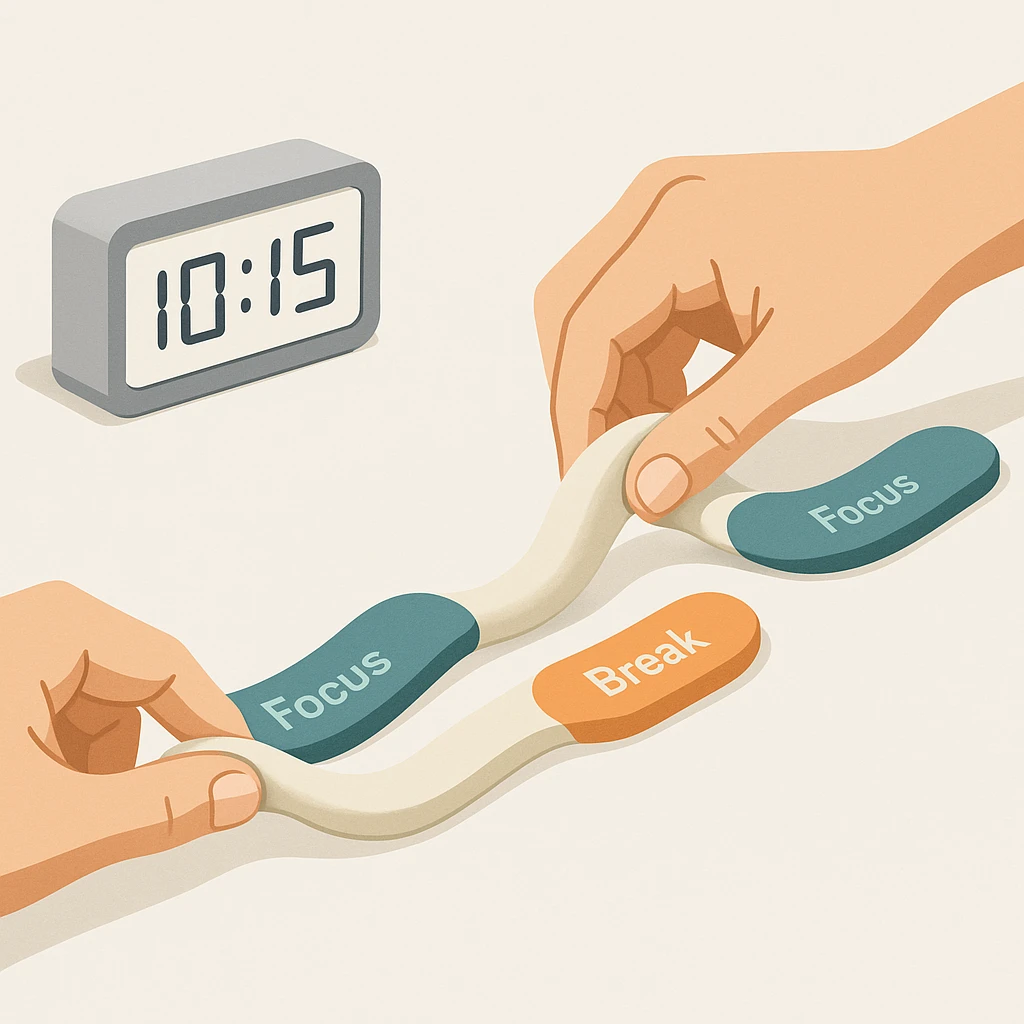
What matters is not being bound to a preset number of minutes and instead thinking in terms of two things: your break ratio and your break points. Here, a “work block” is a span of time you work on a task with sustained focus, and a “break block” is the short rest that follows it. “Break points” are the cues that your focus is starting to dip or a point where the task naturally forms a unit.
First, the ratio. As a rule of thumb, remember to devote 20–25% of your total working time in a day to breaks. For example, after 90 minutes of work, rest 15–25 minutes; after 60 minutes of work, rest 10–15 minutes. When you increase your rest in proportion to how long you worked, it becomes easier to sustain the routine.
Next, about break points in focus. You don’t need special tools.
When you notice signs like rereading the same sentence, taking oddly long to make an easy judgment, or making more typos, that’s a break point. Even if the clock hasn’t reached 90 minutes, stop there and insert a short break block. Restarting will feel much easier.
When incorporating this at work, it’s manageable to place a slightly longer work block in the morning (say, 70–100 minutes) and run multiple shorter work blocks in the afternoon (say, 40–60 minutes). On days with many meetings or messages, simply inserting short work blocks into the open slots can change the overall feel of progress. On days focused on finishing or checks, not making any single work block unnecessarily long helps you maintain decision accuracy.
When incorporating this into study, treat memory consolidation tasks and tasks that build ideas as separate.
If you slip in a very brief pause right before and right after memorization, switching your head goes smoothly. For tasks like essay writing or drawing figures—where stopping mid‑way makes restarting harder—set the work block a bit longer and make sure to rest well at the end; progress is smoother that way. Again here, prioritize your own state of focus over setting a fixed time.
Here’s a concrete example. Suppose a test‑taker is tackling English long‑reading. Spend the first 30 minutes warming up, then if concentration catches, go for another 50 minutes and then just 20 minutes more, cutting at a total of 100 minutes. After that, take a 20‑minute break and a short walk to refresh.
Shorten the next section to 60 minutes and devote it to vocabulary review. The key is not to “fit to 90 minutes,” but to “adjust tasks to fit the flow.”
Finally, a caution. Even when you’re on a roll, prolonged continuous work can sap the next day’s energy. Consider “focus time per work block” separately from “total work time that day,” and be sure to secure your break ratio within the total. This method shows clearer benefits especially for people who tend to work long hours.
Common misconceptions and cautions — don’t turn it into a “one‑size‑fits‑all answer”

- You can’t assert that “90 minutes is scientifically optimal.” While the sleep number is solid, daytime work hasn’t validated a uniform optimum. What we can see so far is that waves sometimes appear on that kind of time scale.
- “It’s the same for everyone” is false. The length you can sustain comfortably varies with task type and time of day. Even if longer blocks suit you in the morning, it’s perfectly natural that shorter, multiple blocks are easier in the afternoon.
- There’s no “correct number of 90‑minute sets.” Because that day’s break points shift with physical condition, sleep loss, temperature, and interpersonal load, prioritize break points over raw minutes, and adjust total break time by ratio (20–25%).
To reiterate the gist: “90 minutes” isn’t the truth; “stopping around the 90‑minute range in line with your own break points is the safe approach.”
Three steps for first‑timers — in two weeks your “break points” will come into view
- Two weeks of simple logging: Note start/end times for work and any signs that your focus dipped along the way (gaze drifting, rereading, more mistakes or yawns). Take a broad look at where durations cluster in the 70–120 minute range.
- Separate morning and afternoon: Make the morning focus sections slightly longer and split the afternoon into several shorter ones, or otherwise change the structure by time of day to smooth out daily within‑day variation.
- Adjust by ratio: Remember to devote 20–25% of your working time to breaks. Focusing on the total allocation instead of fixed minutes makes it easier to keep up. The Flowtime technique is an optimal approach, and if shorter breaks suit you, trying Pomodoro is also fine.
Keep at these three, and your personal “map of break points” will emerge. One person may notice the end of the 9 a.m. hour, another the 2 p.m. hour after lunch, where similar cues tend to appear. Place your schedule to match those. This is a method more reliably effective than chasing a number.
Frequently Asked Questions
Below are common questions about “90‑minute breaks” in Q/A format, with answers that separate what’s solid in research from how to handle it in practice.
Q. “Why ‘90 minutes’?”
A. It has long been known that during sleep, light and deep stages alternate about every 90–120 minutes. Using that number as a clue, a view spread that “roughly every 1–2 hours, there are often waves in attention” even while awake. However, wakefulness is not necessarily precisely carved into “90 minutes.” Use it as a guideline.
Q. “Must I always rest every 90 minutes?”
A. No. When signs of a focus lapse appear (your gaze drifts, you reread the same sentence, easy judgments take longer, mistakes increase), it’s realistic to cut then. Treat time only as a guideline.
Q. “Ninety minutes is too long for me. What should I do?”
A. It’s not uncommon for people’s focus to dip at 60–80 minutes. To find your pattern, keep simple records for about two weeks of work duration, subjective fatigue, and number of mistakes, and adjust to the length at which your focus most often lapses.
Q. “How long should breaks be?”
A. There’s no single right answer. A practical approach is to use a ratio. You’ll likely feel the refresh effect if you devote 20–25% of work time to breaks. The Flowtime technique is recommended. (Examples: after 90 minutes of work, break 15–25 minutes; after 60 minutes, break 10–15 minutes.)
Q. “Should I structure work blocks differently in the morning and afternoon?”
A. For many people, longer blocks are easier in the morning, and multiple shorter blocks keep the burden lower in the afternoon. It stabilizes your day if you place blocks to avoid your valleys (e.g., after lunch).
Q. “Which is correct, Pomodoro or this approach?”
A. Neither is “the” right one; they fit different situations. Deep work that takes time to ramp up suits longer blocks (up to about 90 minutes), while bite‑sized tasks can be easier with the shorter Pomodoro cycle. You can combine them.
Q. “What cues should I watch for when my focus drops?”
A. Three common ones are:
1) Your gaze drifts / you reread the same sentence repeatedly
2) Slower decisions / you hesitate over simple choices
3) More mistakes / typos pile up
If any appear, that’s a cue to step away.
Q. “What should I record in the two‑week self‑measurement?”
A. Start time / end time, subjective fatigue (0–10), and count of small mistakes are enough. If you can later see where break points cluster (e.g., somewhere between 70 and 120 minutes), you’ve achieved the goal. The Flowtime app lets you start a timer immediately and auto‑record.
Q. “So what’s the very first step?”
A. This is enough:
1) Record for just two weeks (work duration, fatigue, mistakes)
2) Longer in the morning / shorter in the afternoon
3) Secure your breaks with a 20–25% ratio
With these three, you’ll be able to use “90 minutes” without treating it as the “answer.”
Summary
The number “90 minutes” comes from sleep research. But the ups and downs of focus that occur during daytime work vary by person, by daily condition, and by the nature of the task. In other words, it won’t always be the same 90 minutes.
There’s plenty of evidence that inserting breaks is good. However, because there’s still no proof that 90 minutes is the optimal interval, think “I’ll pause when I notice my focus starting to dip,” not “I’ll pause because 90 minutes have passed.”
As a starting point for how to run your day, create a work → short break rhythm and remember to devote 20–25% of your workday to breaks. For example, after 90 minutes of work, rest 15–25 minutes; after 60 minutes, rest 10–15 minutes. Treat these as guidelines and shift them to match how you feel that day.
To protect the quality of the day, it’s a manageable approach to advance in consolidated time in the morning and split into shorter units in the afternoon, adapting structure to the time of day. Doing so makes it easier to move both today and tomorrow.
References
- Harvard Business Review “Manage Your Energy, Not Your Time”
- Harvard Business Review “A 90‑Minute Plan for Personal Effectiveness”
- Buffer Blog “The Science of Breaks at Work”
- Chris Bailey “Here’s exactly how long your work breaks should be”
- Chris Bailey “For optimal productivity, be on break for 20–25% of the workday”
- Biological Psychology (Neubauer, 1995) “Ultradian rhythms in cognitive performance: no evidence for a 1.5‑h rhythm”
- Perceptual and Motor Skills (Gordon, 1995) “Ultradian rhythms in performance on tests of specialized cognitive tasks”
- Perceptual and Motor Skills (Hayashi, 1994) “Ultradian Rhythms in Task Performance, Self‑Evaluation, and EEG Activity”
- Frontiers in Neuroscience (Goh, 2019) “Episodic Ultradian Events — Ultradian Rhythms”
- Frontiers in Physiology (van der Veen, 2024) “Re‑scoping ultradian rhythms in the context of metabolism”
- Lifehacker Japan “Three points to ‘optimize your work’ for big results in short time”
- TIME “5 Scientifically Proven Ways to Work Smarter, Not Harder”