Pause Without Polluting Your Focus Record
FlowTime's Pause keeps away time out of both focus and break totals, so stepping away does not ruin the record you use to plan your next session.
 FlowTime
Productivity research, FlowTime updates, and deep‑work know‑how.
FlowTime's Pause keeps away time out of both focus and break totals, so stepping away does not ruin the record you use to plan your next session.
FlowTime lets you edit, switch, complete, and delete tasks while a focus session is running. Here is why that matters for people who lose momentum when the tool gets in the way.
FlowTime tracks real focus time without mixing in breaks, pauses, or missing task labels. Here is why honest stats matter when you use a focus timer for studying or ADHD-friendly work.
FlowTime now offers a Lifetime option for people who want a focus record they can keep without adding another recurring bill.
FlowTime now has a one-time Lifetime plan, a Pause button for stepping away, the ability to edit and switch tasks while staying in focus, and drag-to-reorder in the list view. We also made the stats more accurate and cleaned up the mobile layout.
This article compares FlowTime Focus Timer and Flowmo by to-do app integration, focus record review, pricing, and supported platforms. If you want to keep using Todoist or TickTick as they are, Flowmo is a better fit. If you want to record focus time per task and review it later, FlowTime is a better fit.
FlowTime's paid plans have been revised so Pro is now $1 per month and Premium is now $3 per month. This article explains what you can use on Free, and what opens up with each paid plan.
A practical comparison of FlowTime, Flowmo, Flow, Flowtimer, FlowTimer, Pomodoro | Flowtime, and a Chrome extension for people who want to use the Flowtime or Flowmodoro method with an app. Compare break calculation, task management, stats, sync, blocking, and pricing notes.
As more and more people start using the FlowTime app, we’re adding login & data sync, a new Projects feature, and Pro/Premium plans.
"Have you ever finally gotten into a groove, only to be interrupted by meetings or chat? This article explains how to design a week where you can dive into deep work without stress by combining “Day Theming,” which assigns a work theme to each weekday, with “Flowtime,” which tells you to take a break when you notice signs your focus is slipping. We also share templates you can use immediately as an individual or a team."

Why does work keep expanding and dragging on? Timeboxing is a powerful way to beat procrastination and over‑optimistic estimates by setting a maximum time for each task. From scientific evidence to a concrete two‑week practice plan, and how to pair it with Flowtime to raise focus, this guide explains all the knowledge you need to deliver steady results.

A complete guide to boosting productivity with time blocking. This is a time management technique where you design your day with "boxes" of time to reduce switching costs and improve focus. This guide comprehensively covers everything from how to get started based on scientific evidence to combining it with the Flowtime technique and tips for success.

How to design “focus time” and “smart breaks” to maximize productivity. From spotting when your focus starts to fade, to science‑backed microbreaks, to creative rest that sparks new ideas. This guide explains the full set of techniques for optimizing performance by reading your own “signs.”

"The notion that “taking a break every 90 minutes sustains concentration” began with findings from sleep research, but it isn’t a one‑size‑fits‑all rule. This article unpacks the scientific truth behind the “90‑minute rule” and, with concrete steps, explains how to maximize productivity by spotting your own dip points instead of being bound to fixed times. Let’s discover your personal best focus cycle."

The "incubation effect" is when you get stuck without ideas, but a solution emerges after you deliberately step away from the problem. This article explains the scientific mechanism behind this effect. Furthermore, it provides a practical, research-based guide covering why simply resting isn't enough, the conditions for maximizing the effect, the optimal ways to spend your break, and how to use your time based on different goals. Design "when and what you do when you step away" and unlock your creativity.
Short breaks of under 10 minutes—“micro breaks”—consistently boost motivation and reduce fatigue.

We classify interruptions that hinder focus into three categories—structural, external, and internal—and explain the priority order of the most effective responses. You’ll learn concrete techniques to catch the signs that your focus is about to break and to return to work as quickly as possible.

When you switch tasks, your brain rebuilds goals and rules from scratch. The larger the rule gap, representation gap, and stakes gap, the higher the cost. This article introduces a way to minimize the pain of switching by inserting a task‑bridging act in the 60 seconds before and after the switch.

This article explains how to reduce the time you lose to interruptions at work: decide the very first step you’ll take when (re)starting, write a note in the final 30 seconds before you stop, and standardize your return procedure. If you turn these three into habits over 14 days, your resumption time after interruptions will drop dramatically. This is a practical application of the Flowtime Technique.

A three-stage flow—identify causes → design the switch → automate resumption—combined into one process to reduce dithering and delays in getting back on track.

Clarify which tasks pair well with the Flowtime Technique. It’s effective for long, high‑uncertainty work such as creation and problem solving, while short, routine tasks or work that requires coordination with others are better served by other methods.
To avoid missing the breakpoints in concentration, define stop signs across body, cognition, and behavior to prevent both overruns and stopping too early. Here are criteria to optimize the balance between fatigue and quality.
Three steps to slip back into interrupted work: write your next step in one sentence, calm yourself with three deep breaths, and re‑warm your hands and head with a two‑minute warm‑up.

Introducing a three-step method to slip back into interrupted work: write the next step in one sentence, calm yourself with three deep breaths, and re‑warm your hands and head with a two‑minute warm‑up.

This article explains why information security analysts, who face “alert fatigue” and “fractured focus” during log correlation and incident response, need to maintain a flow state and what the true cost of interruptions is. It then introduces FlowTime, which protects deep analysis by combining 90–120‑minute focus blocks with flexible breaks. The piece also covers how FlowTime reduces false‑positive overhead and nighttime on-call burden, and highlights secure cloud sync with Google sign‑in.

"Aimed at software QA analysts, this article explains why the flow state matters, the costs of interruptions, their impact on efficiency and quality, and how to protect focus while optimizing breaks with FlowTime. Drawing on real-world results and scientific evidence, it presents usage techniques tailored to the challenges of this specific role."

For individuals, students, and self‑learners who know what they should do but can’t get started, this article explains the psychology of procrastination and the cost of interruptions, and proposes a method to enter a focused state from small actions using Flowtime. It presents research on the prevalence of procrastination and its mental burden, data on the time it takes to return after losing focus, and practical adoption examples to drive behavior change.

This article is for learners who struggle with test anxiety and frequent interruptions. It shows how to build a flow state with FlowTime. Drawing on evidence that test anxiety occupies working memory and lowers scores, and that restart costs from interruptions can reduce productive time by up to 40%, it explains the benefits of combining long focus blocks with variable breaks.

For knowledge workers and managers struggling with burnout, this article explains—through research and data—why maintaining a flow state matters and what interruptions really cost, then presents FlowTime as a solution. Against the backdrop of declining global employee engagement and productivity losses driven by interruptions, we propose using FlowTime’s variable breaks and integrated task management to heighten focus, reduce fatigue, and improve outcomes.

"For parents pressed by children’s drop-offs and pick-ups, housework, and work, this article explains how to regain focus with FlowTime and redesign your whole life. Citing survey data, it quantifies the large cost of interruptions and the effects of flow time with concrete figures, and proposes the Flowtime app’s features and the benefits of adopting it."

This article explains how side‑hustlers and freelancers with unstable income can use Flowtime to overcome financial stress and procrastination and focus on revenue‑critical tasks. It outlines the limits of working memory, the true cost of interruptions, and the scientific basis for 90‑minute cycles, and presents Flowtime’s features and adoption benefits with concrete numbers.

This article explains how finance professionals bound by strict IFRS/GAAP standards can use FlowTime’s variable‑break timer and statistics dashboard to reduce interruptions and errors and free themselves from deadline‑driven days.

A complete, step‑by‑step guide to Flowmodoro/Flowtime: the core ideas and how to practice them; the timer‑free routine of “work until your focus breaks → take an appropriate break”; the 20% rest guideline; logging and reflection; tool usage (FlowTime, Toggl, Clockify, RescueTime); common pitfalls and fixes; and smart ways to combine it with Pomodoro so you can start today.
![Same Output, More Fatigue? The Pomodoro Technique’s “Unexpected Side Effect” [Tested with 94 University Students]](/blog/pomodoro-flowtime-self-regulated-study/pomodoro-flowtime-self_top.webp)
In a two-hour experiment involving 94 university students, the results were equivalent, but differences were found in the degree of fatigue and loss of motivation. We will introduce the suitability of Pomodoro, Flow Time, and self-regulation, as well as a procedure for finding the optimal break time in two weeks.
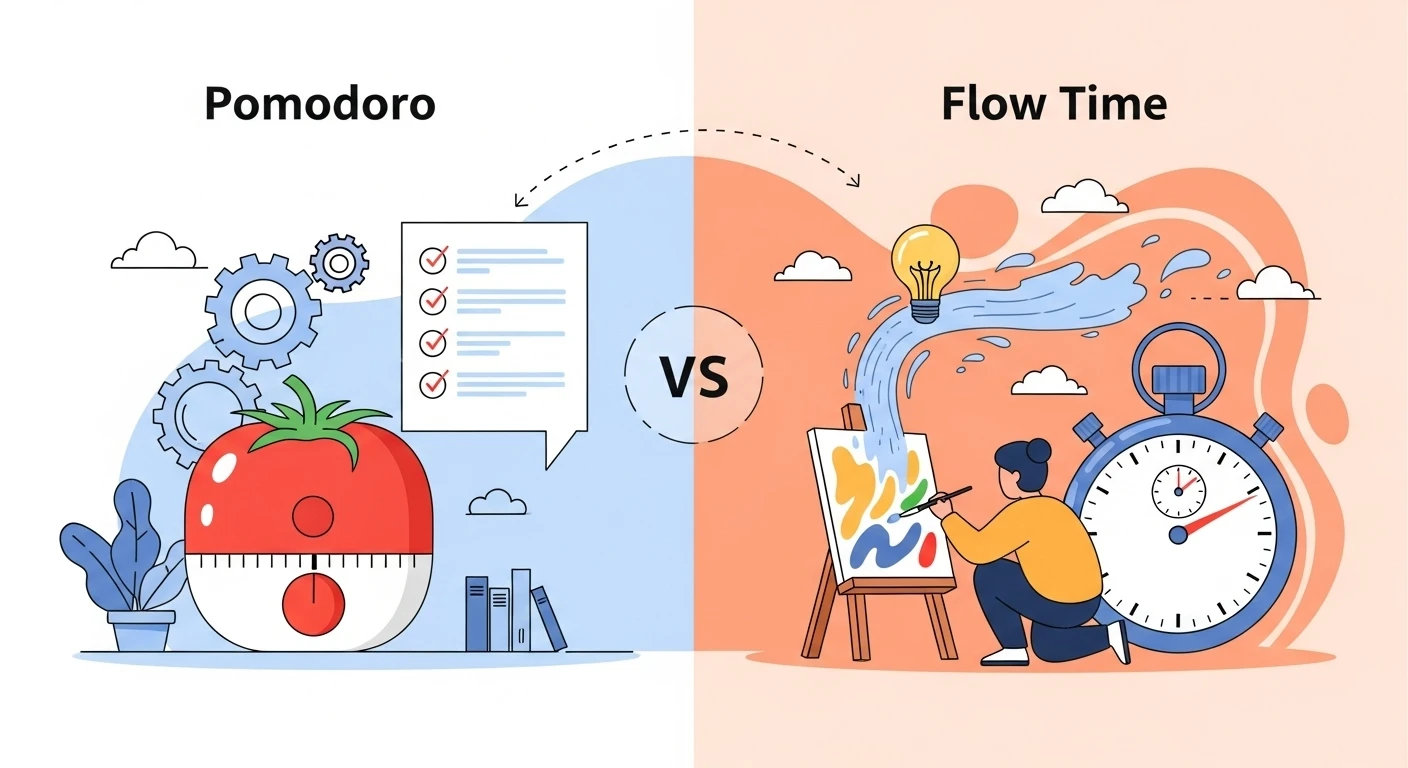
The Pomodoro Technique uses 25-minute sprints, while the Flowtime Technique lets your focus flow uninterrupted. We'll compare their mechanics, benefits, and how to use them for studying and work—all in simple terms. Find out which time management method is perfect for you.

A comprehensive guide on how to start the Flowtime Technique. A step-by-step guide for beginners, covering procedures to maximize concentration without a timer, how to take breaks, and tips for recording and reviewing.
Many people find the strict nature of the Pomodoro Technique limiting. This article thoroughly explains the "Flowtime Technique," a flexible time management method based on scientific evidence. Learn how to find your ideal concentration rhythm while comparing the differences, advantages, and disadvantages with Pomodoro.